
 The 2008 financial crisis was a wake-up call for the global economy, revealing that many homebuyers were entering into mortgages they didn’t fully understand. In response, the U.S. government overhauled the way lenders communicate with borrowers. The result of this massive regulatory shift is TRID. While it might seem like just another acronym in a sea of paperwork, TRID is actually one of the most significant consumer protection laws in the history of real estate.
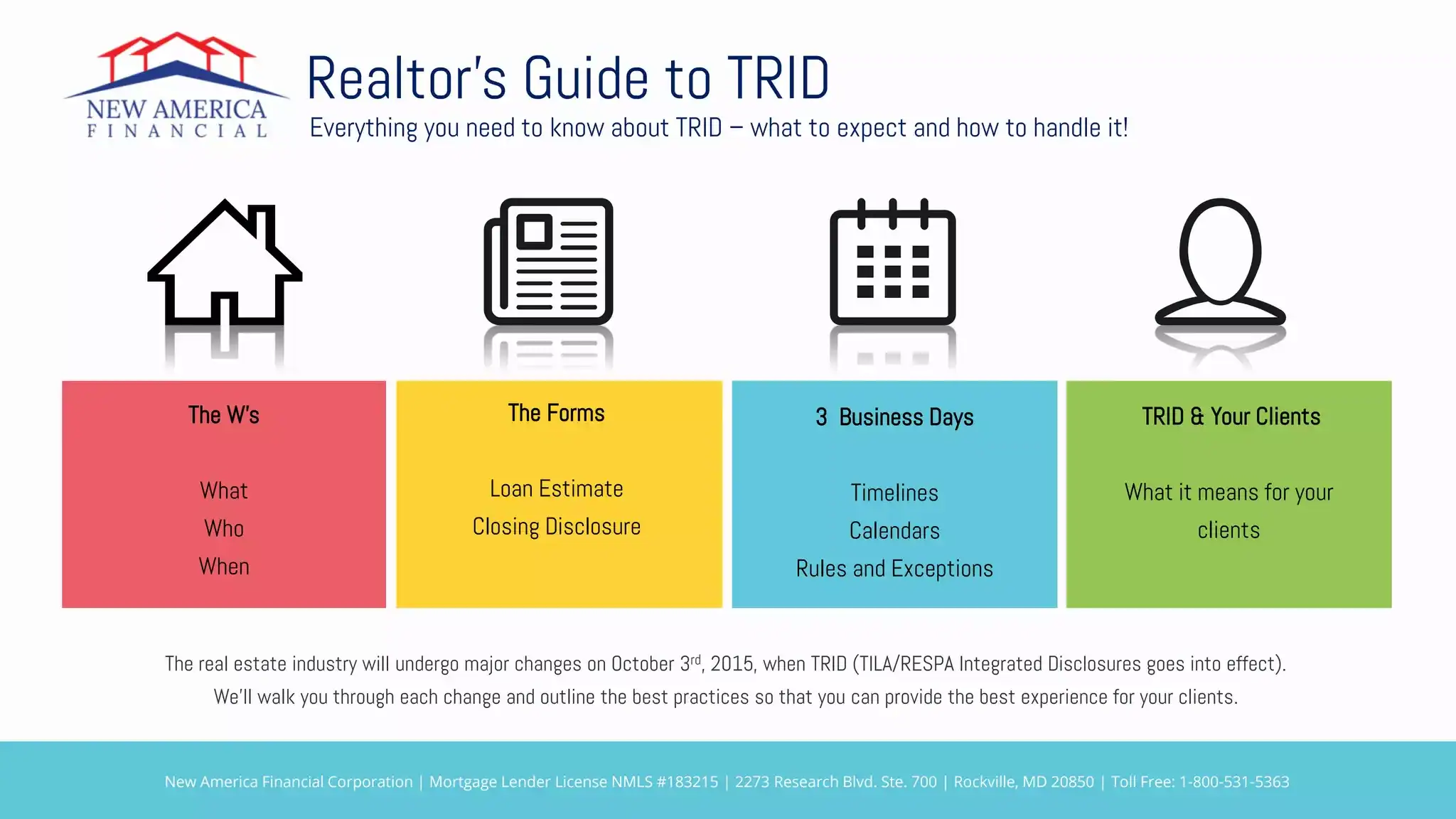
TRID stands for TILA-RESPA Integrated Disclosure. It combined two older sets of regulations—the Truth in Lending Act (TILA) and the Real Estate Settlement Procedures Act (RESPA)—into a single, streamlined process. Often referred to as the “Know Before You Owe” rule, TRID ensures that you know exactly what your loan will cost before you are legally committed to it.
The Two Pillars of TRID: Loan Estimate and Closing Disclosure
Before TRID, borrowers were often overwhelmed by a “Good Faith Estimate” and a “HUD-1 Settlement Statement” that didn’t look anything alike. TRID replaced these with two easy-to-read documents that use identical formatting, making it easy to spot if a lender has changed the terms at the last minute.
1. The Loan Estimate (LE)
Within three business days of applying for a mortgage, your lender must provide you with the Loan Estimate. This three-page document tells you the estimated interest rate, monthly payment, and total closing costs for the loan. It also highlights whether the loan has risky features like a “balloon payment” or “prepayment penalty.”
2. The Closing Disclosure (CD)
At least three business days before you close on the house, you must receive the Closing Disclosure. This is the final version of your loan’s terms. TRID mandates this three-day window so that you have time to compare the CD to the original LE. If the costs have increased significantly, you have the right to ask why—and in some cases, the lender is legally prohibited from raising certain fees.
The “Three-Day Rule”: Why TRID Can Delay Your Closing
One of the most famous (and sometimes frustrated) aspects of TRID is the mandatory waiting period. If there is a “significant change” to the loan after the CD has been issued, the three-day clock restarts. Significant changes include:
- The APR (Annual Percentage Rate) increases by more than 1/8th of a percent.
- A prepayment penalty is added to the loan.
- The lender changes the loan product (e.g., switching from a fixed-rate to an adjustable-rate mortgage).
While this can be annoying for a buyer who is under contract and ready to move, it is designed to prevent “bait-and-switch” tactics where lenders change terms at the closing table when the buyer feels forced to sign.
What TRID Does Not Cover
It is important to note that TRID does not apply to every type of real estate transaction. It is specifically designed for consumer mortgages. Therefore, it typically does not cover:
- Reverse mortgages.
- Home equity lines of credit (HELOCs).
- Commercial real estate loans (where an LOI and T12 are more common than a Loan Estimate).
- Mobile homes not attached to a permanent parcel of land.
- Cash transactions (since there is no lender involved).
The Impact of TRID on the Real Estate Industry
When TRID was first implemented in 2015, the industry panicked. Closings took longer, and software systems had to be completely rewritten. However, nearly a decade later, the benefits are clear. Homebuyers are more educated, and there are fewer disputes at the closing table.
For real estate agents, TRID means that timing is everything. You cannot rush a closing. If a buyer and seller negotiate a last-minute credit for a latent defect found during the final walkthrough, it might change the numbers enough to trigger a new CD and a new three-day wait. This is why clear communication between the agent, the lender, and the title company is more important than ever.
Conclusion: Empowerment Through Transparency
TRID is your greatest ally as a borrower. It strips away the complexity of mortgage lending and forces transparency. By providing standardized forms and mandatory waiting periods, TRID ensures that your “dream home” doesn’t turn into a financial nightmare because of hidden fees or fluctuating interest rates.
As you move toward the final settlement statement, take the time to read your TRID disclosures line-by-line. It is your right to know before you owe. Want to learn more about the legal protections in a sale? Check out our article on ALTA in real estate to see how your title is protected. You might also be interested in how comps affect the initial loan estimate by reading our guide on real estate comps.