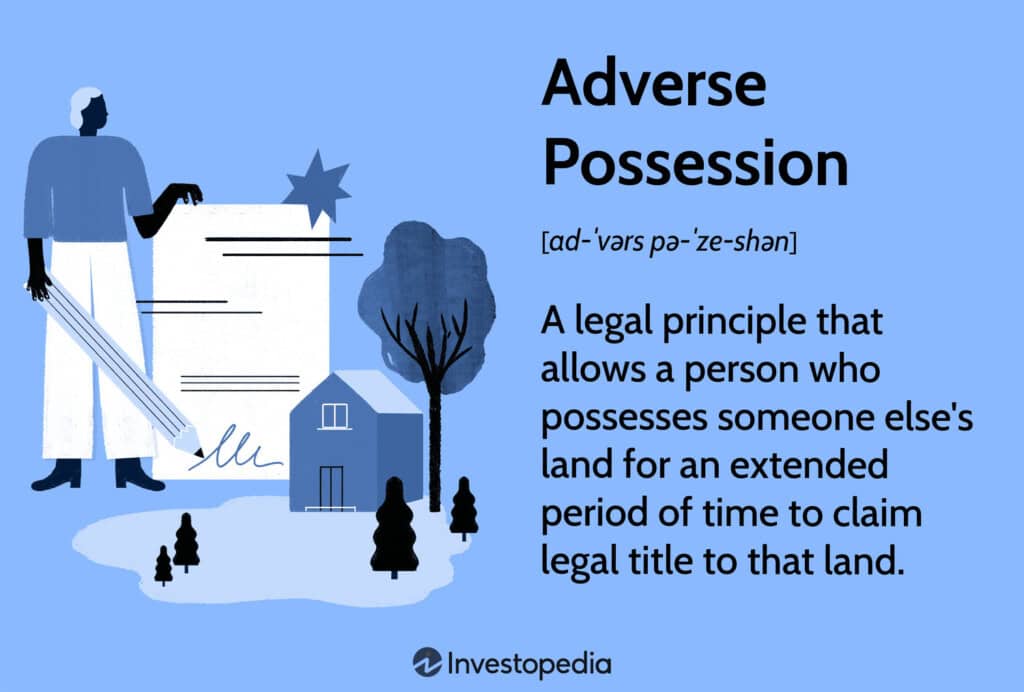
 The concept that someone could move onto your land, live there without your permission, and eventually become the legal owner sounds more like a medieval legend than modern law. Yet, adverse possession—often colloquially known as “squatter’s rights”—is a very real legal doctrine active in every U.S. state. It is rooted in the “use it or lose it” philosophy, where the law rewards the productive use of land and punishes “sleeping” owners who ignore their property for decades.
Adverse possession is a process by which a person who is not the legal owner of a parcel of land can acquire title to it by occupying it for a specific period. While it is rare for someone to take over an entire house this way, it happens frequently in boundary disputes, where a neighbor’s fence or driveway has been on the “wrong” side of the line for twenty years.
The Legal “H.O.C.A.N.” Test: Requirements for a Claim
You can’t just pitch a tent for a weekend and claim ownership. To win an adverse possession case, the occupier must meet five strict legal criteria. If even one is missing, the claim fails. These are often remembered by the acronym H.O.C.A.N.:
- Hostile: The occupier must be there without the owner’s permission. If the owner says, “Sure, you can park there,” it is no longer adverse; it is a license.
- Open and Notorious: The occupation cannot be a secret. It must be obvious to anyone—including the owner—that someone is using the land. Think of building a shed or planting a garden.
- Continuous: The occupier must use the land without interruption for the entire statutory period, which varies by state from 5 to 30 years.
- Actual: The person must physically treat the land as an owner would (mowing, fencing, or building).
- Notorious/Exclusive: The occupier must not share the possession with the general public or the true owner.
Adverse Possession vs. Prescriptive Easement
Many people confuse adverse possession with a prescriptive easement. The difference lies in what you “get” at the end. Adverse possession results in a transfer of the title—you own the land. A prescriptive easement only grants you the right to use the land. For example, if you use a neighbor’s path to reach the beach for 20 years, you might get an easement to keep walking there, but you don’t own the path.
The Role of Property Taxes
In several states, such as California and Florida, the “hostile” occupier must also pay the property taxes on the parcel for the entire statutory period to claim ownership. This is a high bar to clear, as tax bills are usually sent to the owner of record. If the occupier manages to intercept the bill and pay it for years without the owner noticing, the court sees this as strong evidence of “acting like an owner.”
How to Prevent Adverse Possession
As a property owner, your best defense is a “minimal act of ownership.” Since the claim must be hostile, simply giving written permission to a neighbor to use a portion of your land immediately kills their ability to claim adverse possession later. Other preventive steps include:
- Regular Inspections: Walk your boundary lines once a year to look for new fences or structures.
- Post “No Trespassing” Signs: While not a total cure, it helps establish that any use is not authorized.
- ALTA Surveys: If you are buying a home, always get an ALTA survey. It will show if a neighbor’s garage or fence is encroaching on your land before you sign the PSA (Purchase and Sale Agreement).
The Impact of “Tacking”
One interesting quirk of this law is “tacking.” If Occupier A uses your land for 5 years and then sells their house to Occupier B, who uses it for another 5 years, those years can be added together (tacked) to meet a 10-year requirement. This is why boundary disputes often arise decades after a fence was originally built by people who no longer live in the neighborhood.
Conclusion
Adverse possession serves as a reminder that property ownership is not just a right, but a responsibility. By forcing owners to be aware of their land’s boundaries, the law ensures that land remains a productive asset rather than a neglected wasteland. Whether you are dealing with a small encroachment or a complex REO property, understanding these “invisible” shifts in ownership is critical.
Worried about the legal status of your property? You should also familiarize yourself with escheat in real estate to understand what happens if a property is left truly abandoned without any heirs. For those currently in a transaction, make sure your settlement statement reflects a clear title free of any such claims.